
(Okay, quick public announcement—this history nerd is making Wednesday women’s day in my crusty corner of the internet!)
August. Back to School Month.
Proud parents are currently blasting first-day-of-school pictures on social media, stores are lined with all the classroom goods of glue sticks, crayons, backpacks galore while school busses have been resurrected from their summer slumber and are now heaving and trotting along the streets.
That wonderful line in You’ve Got Mail says it best for me, “It makes me want to buy school supplies. I would send you a bouquet of sharpened pencils if I knew your name and address.”
School is just so normal these days. From pre-school to college, shoot there’s even clown school here in America. (No joke🤡.)
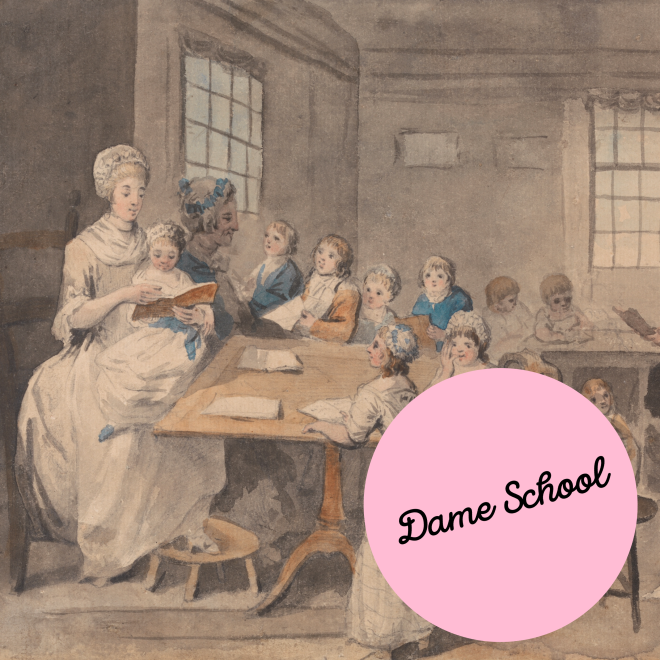
But what about the first schools in America? More specifically, schools for girls? What if you, or your daughter, were a Colonial girl in America in the 1600s/1700s? Well, you would be clicking your buckled shoes and heading off to DAME SCHOOL.
Quick Context:
Obviously, education looked a lot different in early America. Tax funded public education wasn’t really a thing until the 1800s. Parents had to pay out of pocket for their children’s education which was usually a hefty sacrifice. Considering sons would eventually become sole breadwinners, parents prioritized investing in their son’s education. But even then, Colonial boys weren’t exactly sent off to school school. Only sons of the wealthy elite were sent to private schools where they were taught lofty subjects such as Latin, astronomy, philosophy,etc. The average early American boy was set up for an apprenticeship, or what we like to call vocational training or trade school today.
Even then, girls weren’t entirely withheld from an education. Colonial families, both poor and rich, sent their daughters to what were called Dame Schools.
Dame School, You Say?
A Dame School was usually in the home of an elderly woman in the community. In fact that is the archaic (pre-1940’s slang) use of the word meaning elderly or mature woman. It was a fairly informal environment with the curriculum depending on the dame in charge. Typical subjects, however, were basic reading, writing, and math combined with more genteel skills such as needlework, sewing, household management and social graces, i.e. how to make polite conversation and pour tea like a proper lady.
In other words, a home economics class and charm school. But back then it was simply Dame School.
 Doris Day Would Love Me